 hillsandbooks96
5/27/2026

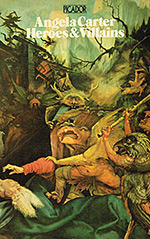
A post-apocalyptic tale, this one told through the feminist lens of Angela Carter. The prose is characteristically florid and exotic, appropriately fitting given the setting - which is a land overtaken by vibrant plants and poisonous snakes. Marianne, the protagonist, is from a caste known as the Professors which is subject to a raid by the nomadic, rival clan of Barbarians who do not measure time; this contrasts with how Marianne is introduced, where she keeps her father’s clock like a pet because it "continued to tick inscrutably on" - unlike her rabbit, which died. After her brother is killed in the raid, Marianne goes with one of the raiders, a barbarian called Jewel, who intends to take her as a wife.
This story is much, much darker than that of Nights at the Circus, the only other Carter novel I’ve read; and it is firmly a story driven by character, the development of which is strong, than it is by plot, which, conversely, is light. It deconstructs the idea of the ‘savage’ and the ‘civilised’, a theme portrayed in one of its most obvious manifestations in something like Tarzan of the Apes, where the ‘savage’ is tamed by someone from a more ‘civilized’ society. In Heroes and Villains however, Jewel is so rigidly embedded in the system of his own culture that he does not seek or need ‘civilising’, and indeed Marianne ends up taking what she has learnt and observed from the Barbarians to take charge of her own life, in contrast to her earlier self who was raped and forced into a marriage. It made me think, perhaps unusually, of Michael Swanwick’s The Iron Dragon’s Daughter - which is a deconstruction of fantasy tropes - in which the protagonist, Jane, breaks free and escapes from sexual coercion and exploitative labour by adopting the ruthless, survival-of-the-fittest outlook she has observed in those around her.
When Marianne is with the Barbarians, she encounters others who were also once part of the same Professor class, the resident doctor/mentor figure called Donally who keeps his son locked in a cage like a dog - like how Marianne is ‘caged’, not physically, but by the fact she is pregnant with Jewel’s child and by the hostile environment beyond the settlement - as well as Jewel’s foster mother Mrs Green, who is sometimes sympathetic to Marianne’s mistreatment but often powerless to do anything about it. The terrifying thing is how they have both ultimately adapted to the Barbarian system and, in Donally’s case, taken to it with enthusiasm; it is revealed that Donally chose to join with the Barbarians of his own volition.
There’s also a parallel drawn by Carter to the ‘forbidden fruit’ of Adam and Eve, reinforced by reoccurring appearances of poisonous snakes, the story of which is portrayed in a tattoo on Jewel’s back, which Marianne sees shortly after being offered a poisoned porridge at breakfast. Also present is how the Barbarians, despite her having come from a ‘Professor’ clan, view Marianne with superstition around her supernatural nature or possession of magics, warding off the evil eye in her presence. Yet, it is Marianne who similarly holds a superstition in the ruined remnants of Earth’s cities playing home to ghosts. Through this, both clans are portrayed as holding irrational beliefs, in different ways.
A couple of interesting things I noticed towards the end of the novel were during Jewel and Marianne’s final journey in which, firstly, they come to the coast and see various new creatures and vegetation, ‘ceasing to be known’ in a manner I interpreted as mirroring Marianne’s own experience within the Barbarian society:
Losing their names, these things underwent a process of un-creation and reverted to chaos, existing only to themselves in an unstructured world where they were not formally acknowledged, becoming an ever-widening margin of undifferentiated and nameless matter surrounding the outposts of man, who no longer made himself familiar with these things or rendered them authentic in his experience by the gift of naming.
Following this was more of Carter’s hallucinatory descriptions which put me in mind of the mirage-like imagery of British New Wave contemporary, J.G. Ballard’s, Vermilion Sands:
Here was a time-eaten city up to its ears in the sea, its towers, domes and roofs so mingled with their own shadows and reflections that all seemed to hang in mid-air, among clouds of night and waning stars. Long ago the sea wrenched apart the massive blocks of an esplanade, though these were tons in weight and clasped together; then the sea swirled through the abandoned thoroughfares nibbling, gobbling, gulping and digesting stone, brick, stucco, metal and concrete. Now incurious fish swam in bedrooms where submerged mirrors reflected faces no more, only the mazy dance of wrack and wreckage; fish swam through ocean-gone ovens and out again, uncooked; fish in their native element went gaping through ballroom, store and hotel in this town which had once been a resort built for purposes of pleasure.
This is a very thematically dense novel for its short length, which is perhaps the best testament to Carter’s skill, producing a work by her which yet again I found to be very interesting. Safe to say that Carter is a writer who has caught my attention.
http://https://www.goodreads.com/user/show/158820077-dan-roebuck