 hillsandbooks96
5/29/2026

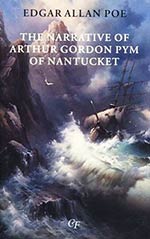
The Narrative of Arthur Gordon Pym of Nantucket has the dubious honour of being Poe’s only novel, and while the 'only novel' worked out alright for playwright and poet Oscar Wilde with The Picture of Dorian Gray, I think in the case of Arthur Gordon Pym, it's not the ideal place to start with Poe's work. The story is written as a travelogue or journal, and there is no dialogue, only description. It follows the titular character and his friend Augustus who end up onboard the Grampus, whose captain is victim of mutiny. Two factions form among the crew, and various calamities befall the ship and its crew including intoxication, madness, drownings, storms, and ghostly hauntings. There are several pauses in the action made to address details such as wind bearings and how a ship steers, however these don’t provide the same pleasure to read as the ‘digressions’ in Moby Dick do; they are instead punishingly dry, and I began skipping over them when they arose.
There are some flashes of atmospheric writing, and while the novel premise might suggest the presence of varied and interesting characters, the absence of dialogue means that any sense of ‘character’ is non-existent. The writing is simplistic, not particularly poetic, and I think not a good representation of what Poe was capable of. The writing suffers from a verbosity and overuse of commas and clauses that makes the structure of every sentence repetitive and predictable, and even though it is quite a short novel already, I can’t help but feel it could have been made even shorter by removing every unnecessary use of ‘indeed’ or ‘however’.
Interestingly, upon researching this, it appears even Poe himself dismissed this book sometime after its publication. It hasn’t put me off reading more of him – I have some collections of his more celebrated poems and short stories on my shelf to get to – but his successors such as Herman Melville and Robert Louis Stevenson did the maritime fiction and fantasy adventure stories respectively to a better standard than Poe did here. The influence on Melville is perhaps most clear in Poe’s interweaving of encyclopaedic, non-fictional segments on the history of exploration to Melville’s chapters on cetology in Moby Dick, however I think Melville executed this technique far more gracefully in that novel than Poe did here. There is a long digression made about the history of Antarctic exploration which seemed tonally at odds with the narrative, which at that point had started becoming increasingly weird (‘weird’ here meaning in the literary sense and sub-genre of fiction Poe was the progenitor of). We then get a Typee: A Peep at Polynesian Life-like segment on an island inhabited by a native tribe, before the novel abruptly ends with While this might sound like one of those strange, ambiguous endings found in later cosmic horror, here it feels more like Poe simply didn’t know how to end the story.
Overall, it was quite uneven, tonally inconsistent, but was still of some interest purely for tracing the lineage of weird fiction, cosmic horror, and maritime fiction more broadly.
http://https://www.goodreads.com/user/show/158820077-dan-roebuck