 hillsandbooks96
6/3/2026

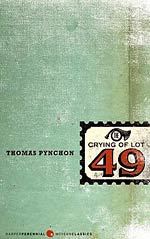
The Crying of Lot 49 both being on David Pringle’s list and widely considered Thomas Pynchon’s most accessible novel is a rather lucky pair of circumstances. Of all the novels I’ve read, the one it reminds me of to a remarkable degree is Philip K. Dick's Ubik. In Lot 49, we have Oedipa Maas who is made executor of the will of her former lover - the real estate tycoon Pierce Inverarity - after his passing. She then gets caught up in a surreal, shifting world of bureaucracy that necessarily follows the death of a real estate mogul, enigmatic symbols signifying a postal system known as W.A.S.T.E – or the ‘Trystero’ - and odd characters with names such as Genghis Cohen, Dr Hilarius, and her husband, ‘Mucho Maas’. This maps notably closely onto Ubik’s plot concerning Joe Chip attempting to traverse a world of decay and reverse entropy (entropy also getting a mention in Lot 49 during a scene in which Oedipa confronts the mad Dr Hilarius) and inexplicably seeing Glen Runciter’s face everywhere in a hyper-consumerist, surreal alternative of California, of where Dick was a resident - particularly Berkeley, a location which also gets a mention in Pynchon’s novel.
Published in the late 60s, Lot 49 also shares some of that psychedelic, counter-cultural disposition that Dick’s slightly later Ubik does; both feature appearances of subcultures and less ‘polite’ parts of American society in the characters that move in and out of the narrative (not limited to a proto-punk rock band appropriately named The Paranoids), and LSD use is explicitly mentioned in the Pynchon work. It does differ from Ubik in that the barrier to entry is higher, both in a literary sense and in the cultural references - much of what Pynchon references with regard to entertainment, media and I assume the inefficiency of the US postal system was often lost on me as a non-American, and perhaps this is a reason why Pynchon does not occupy the same literary space outside his domestic market as he does within it. The “clues” Oedipa gets to uncovering the nature of the Trystero become increasingly convoluted and esoteric, stretching from 17th Century European politics to the American Civil War, heightening the humour and sense of paranoia. Additionally, the opportunity for Oedipa to follow up on any of these clues or her contacts disappear as characters either descend into a guilt-ridden breakdown – as in the case of Dr Hilarius – or the second-hand bookshop occupying Inverarity’s former real estate burning down shortly after Oedipa’s visit to it.
How seriously Pynchon intends for you to take this novel it appears is also debatable; when Oedipa goes to see a play called The Courier’s Tragedy, a meta-textual technique used to echo Oedipa’s predicament and question whether the Trystero has a long and storied past embedded throughout time like a secret history, she meets the play’s director, a Randolph Driblette, who tells her:
You came to talk about the play. Let me discourage you. It was written to entertain people. Like horror movies. It isn’t literature, it doesn’t mean anything.
And, then:
You want to do that? You can put together clues, develop a thesis, or several, about why characters reacted to the Trystero possibility the way they did, why the assassin’s came on, why the black costumes. You could waste your life that way and never touch the truth.
If this is Pynchon speaking through the characters is where I suppose the question lies. The fact that Driblette not only directs the play but appears in it as one of the cast members may be comparable to Pynchon being the writer (director) of The Crying of Lot 49 and ‘appearing’ in the book by using the characters to voice his own thoughts. Either way, one needs a strong appetite for absurdity, metafiction and surrealism to enjoy this novel, and as I have long had an affection for Flann O’Brien’s The Third Policeman, I was probably somewhat well-equipped to appreciate what Pynchon is doing here. Veering very closely to the territory of a 5-star read, perhaps only falling just short of that rating due to the density of references keeping me somewhat at a distance.
http://https://www.goodreads.com/user/show/158820077-dan-roebuck